

From ancient times to the modern day, we often overlook the complex chemistry at play in the simple act of lighting a candle. As I delve deeper into the processes behind a candle’s glow, an intriguing world unfolds where energy and matter intertwine. The burning of a candle is a staple example in educational settings, showcasing the dynamic interplay between chemical and physical changes, all the while manifesting observable energy.
Equipped with a keen eye for scientific scrutiny, I have carefully conducted observations to unravel the evidence pointing towards the transformational nature of lighting a candle. From solid paraffin wax to gaseous new substances, I have witnessed how candle wax molecules alter states and react chemically with oxygen in the air through combustion, releasing both light and heat.
Key Takeaways
- Lighting a candle involves complex chemical and physical changes.
- Wax molecules alter states from solid to liquid to gas, reacting with oxygen in the air.
- Combustion is the primary chemical change in a candle flame.
- Through scientific observation, we can better understand the interplay between energy and matter in a burning candle.
- Candles provide an accessible example to explore chemical transformations in daily life.
The Enigmatic Nature of Candle Flames
A burning candle may seem simple at first glance, but it harbors an intricate network of chemical processes and changes in states of matter. From the candle’s wick and wax composition to the combustion reaction occurring with atmospheric oxygen, this seemingly ordinary object serves as a fascinating subject for scientific exploration.
The Composition of a Candle
The primary components of a candle are the wick, which is typically made of cotton, and the surrounding wax. The wax itself is primarily comprised of hydrocarbons, long-chain molecules that provide a suitable fuel source for the candle flame. There are various types of wax used in candles, like paraffin, beeswax, and soy wax, each with their unique chemical properties and attributes.
What Happens When a Candle Burns?
When a candle is lit, several fascinating processes begin to unfold. The heat from the flame first melts the wax, allowing it to be drawn up the wick through capillary action. This liquid wax then heats further, transitioning into a gaseous state. At this point, the ultimate question arises: is burning a candle a chemical reaction?
As the gaseous wax comes into contact with atmospheric oxygen, a combustion reaction occurs. This process involves the continuous breaking of chemical bonds within the hydrocarbon molecules and the formation of new bonds between the carbon, hydrogen, and oxygen atoms. Ultimately, the chemical reaction gives rise to two primary combustion products: carbon dioxide (CO2) and water vapor (H2O). The release of energy in the form of heat and light is the byproduct of this candle flame chemistry phenomenon.
Physical Vs. Chemical Changes Explained
To discern whether lighting a candle is a physical or chemical change, one must understand the defining characteristics of each. Physical changes involve alterations in the state or shape of a substance without changing its chemical identity. Chemical changes, on the other hand, lead to the formation of new substances with different molecular structures and properties.
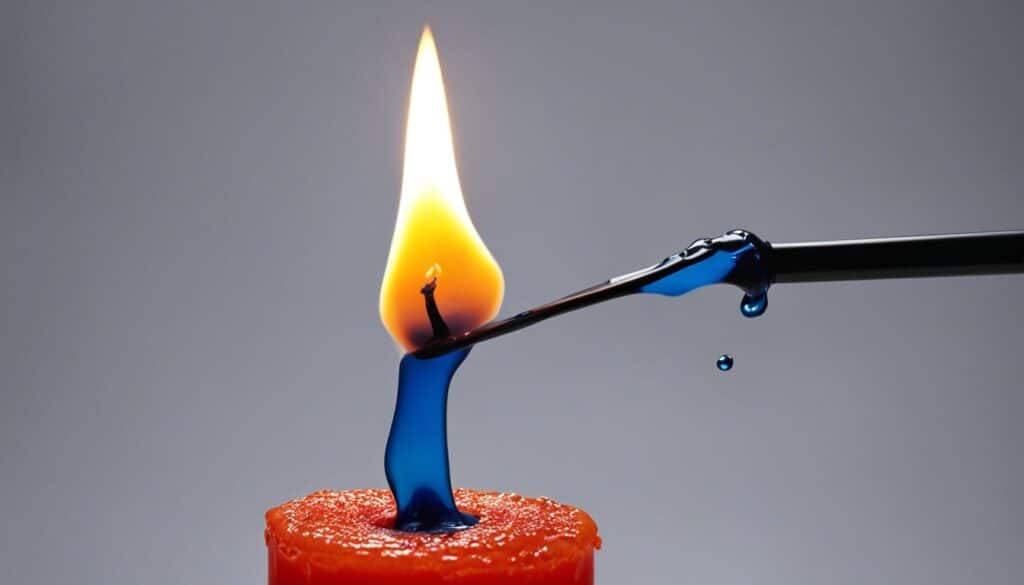
A burning candle encapsulates both processes: melting wax represents a physical change, while the combustion, producing heat and light through the interaction of wax vapor and oxygen, epitomizes a chemical change. This nuanced understanding provides clarity in recognizing the combustion of a candle as a fundamental chemical reaction, making the act of lighting a candle an event of chemical metamorphosis.
“A burning candle encompasses both physical and chemical changes, from the melting of the wax to the combustion process producing heat and light.”
Examples of physical and chemical changes in candle burning can be illustrated as follows:
| Physical changes | Chemical changes |
|---|---|
| Wax melting | Combustion |
| Wax changing state (solid to liquid to gas) | Interaction of wax vapor and oxygen |
| Wick absorbing liquid wax | Production of heat and light |
By examining the actions that occur during the combustion process in candles, it becomes clear that the act of lighting a candle is not purely a physical change, but instead a complex interplay between physical and chemical transformations. This understanding helps to demystify some of the chemistry that glisters behind one of humanity’s most timeless sources of light and warmth.
Is Lighting a Candle a Chemical Change
An exploratory investigation into lighting a candle reveals a multitude of nuanced observations. During burning, the compositional change from a solid wax molecule to liquid and eventually gas form serves as a prelude to the chemical transformation. In order to gain a better comprehension of these changes, it is crucial to understand the properties of chemical reactions and observe the evidence that supports the claim that lighting a candle is indeed a chemical change.
Understanding Chemical Reactions
Chemical reactions are processes in which the atoms of one or more substances rearrange and create new substances with distinct properties. These transformations involve the breaking of chemical bonds in the reactants and the forming of new bonds in the products. The chemical reaction of candle wax when lit involves the combustion of hydrocarbons found in the wax, reacting with oxygen and producing heat, light, carbon dioxide, and water vapor. This type of reaction is exothermic since it liberates energy in the form of heat and light.
Evidence of Chemical Transformation in Candle Burning
Several observations provide evidence for the chemical transformation occurring in a lit candle. Some of these indicators include:
- The heat and light output resulting from the combustion reaction
- The gradual diminishment of the candle wax itself, indicating the consumption of wax as a reactant
- The aromas produced from various chemical compounds generated through combustion
Furthermore, the chemical equation for this reaction clearly showcases the conversion of hydrocarbons in the wax and oxygen into new products:
CnH2n+2 + (3n + 1)O2 → nCO2 + (n+1)H2O
This equation demonstrates that lighting a candle is a definitive chemical change, contrasting with mere physical shifts observed in the melting and evaporation of the wax.
Candle Lighting Chemical Reaction
The chemical reaction inherent in candle lighting is a testament to the intricacies of simple daily activities. As the flame ignites, a teeming world of chemical activity unfolds. Within the confined space around the wick, solid wax embarks on a journey through states of matter, transitioning into a liquid and further into a gas, subsequently engaging in a chemical reaction with oxygen to emit carbon dioxide and water vapor—signatures of a chemical change.
These products are created through the structural alterations of the molecules involved, signifying a permanent change contrary to the conservative nature of physical changes. Let’s take a closer look at the chemical properties of a burning candle and how they contribute to this intriguing process:
- Wax composition: The primary constituent of candle wax is hydrocarbons, with different wax types containing variations in molecular structures.
- State transitions: Upon burning, the solid wax melts into a liquid and then vaporizes, transitioning through all three states of matter.
- Oxygen interaction: Gaseous wax molecules then interact with oxygen molecules in the air, initiating a combustion reaction.
- Combustion products: This interaction results in the formation of new molecules, specifically carbon dioxide and water vapor.
| Process | State of Wax | Chemical Interaction | Resulting Products |
|---|---|---|---|
| Initial state | Solid | – | – |
| Melting | Liquid | – | – |
| Vaporization | Gas | – | – |
| Combustion | Gas | Wax + Oxygen | Carbon dioxide + Water vapor |
In conclusion, the fascinating journey of a candle’s wax through various states of matter and its ultimate engagement in a combustion reaction with oxygen undeniably illustrates the occurrence of a chemical change in a candle flame. Thus, lighting a candle is a prime example of a chemical reaction embedded within our everyday lives.
The Combustion Process in Candles
When it comes to understanding the chemical changes occurring while burning a candle, the combustion process plays a vital role. A closer look into the reactions that happen as a result of oxygen’s interplay with vaporized hydrocarbons provides further insights into this fascinating phenomenon.
The Role of Oxygen in Candle Burning
Oxygen is the central player in the combustion process of a candle. As a candle burns, oxygen from the surrounding atmosphere is consumed, allowing wax molecules to transform from a condensed state into gaseous constituents. These vaporized hydrocarbons, aligned with the principles of combustion chemistry, interact with oxygen to foster a chemical reaction that emanates light and heat.
Is Burning a Candle a Chemical Reaction?
Upon understanding the role of oxygen in candle burning, it becomes evident that lighting a candle is indeed a chemical reaction. This exothermic reaction not only produces new chemical substances—carbon dioxide and water—but also releases energy. Thus, burning a candle complies with the hallmarks of chemical changes, establishing it as a chemical reaction, in stark contrast to purely physical transformations. These fascinating observations confirm that candle flame chemistry is an essential component of understanding whether lighting a candle is a chemical change.
Chemical Properties of a Burning Candle
While observing a burning candle, one might not immediately recognize the astounding chemistry taking place. However, when delving deeper into the structure and properties of candle wax, we unveil the intriguing process of chemical transformation in candle burning and the combustion process in candles, from solid wax into energy and new chemical substances.
The Chemical Formula of Candle Wax
Candle wax predominantly consists of long-chain hydrocarbons, with specific components varying depending on the wax source. For instance, paraffin wax, a common ingredient in candles, primarily contains molecules such as C18H38. These hydrocarbon molecules form the foundation for the chemical reactions that unfold when a candle is lit.
Chemical Reaction of Candle Wax When Lit
Upon lighting, these hydrocarbon molecules undergo a series of changes, starting with melting and then transitioning into a gaseous state through the process of vaporizing. At this stage, these vaporized hydrocarbons engage in a combustion reaction with oxygen. The representative chemical equation for this reaction can be shown as:
| Reactants | Products |
|---|---|
| Wax (C18H38) + Oxygen (O2) | Carbon Dioxide (CO2) + Water (H2O) |
The balanced chemical equation illustrates how wax and oxygen react to form carbon dioxide and water, releasing energy in the process. This reaction validates the chemical nature of the interactions taking place as the candle burns, and ultimately serves as evidence that lighting a candle is indeed a chemical reaction.
The Chemistry Behind a Candle Flame
Dissecting a candle flame into its numerous zones reveals varied chemical activity and temperatures at play. Each zone, both luminous and non-luminous, sheds light on the complex chemistry unfolding within the flame. Contrary to the common misconception that attributes the candle flame exclusively to physical phenomena, the different zones serve as stages exhibiting a series of oxidative chemical reactions that are crucial to maintaining the flame. This chemical combustion is accompanied by physical changes such as melting and evaporation of wax, emphasizing the coexistence of both chemical and physical changes within the candle flame.
Upon demystifying the visuals of a candle flame, we can recognize and appreciate the core chemical processes responsible for the flame’s persistence and quintessential radiance. This understanding helps to clarify the true nature of the processes occurring within the flame: is burning a candle a chemical reaction? By acknowledging the various chemical transformations and recognizing the physical changes that occur simultaneously, we arrive at the conclusion that, indeed, burning a candle is a complex interplay of both chemical and physical changes, where oxidation reactions lie at the heart of the matter.
Chemical Change in Candle Flame: The Evidence
As we explore the various aspects of candle burning, evidence supporting the chemical nature of a candle flame is found both in observable phenomena and controlled experimental conditions. In this section, we will focus on visual indicators that hint at the underlying chemical transformations, as well as the importance of maintaining a controlled environment during experimentation.
Visual Indicators of Chemical Change
Throughout the burning process, we can observe distinct signs that support the notion of chemical change taking place. For instance, the formation of soot when a candle flame is interrupted, which suggests incomplete combustion due to limited oxygen availability, indicates that ongoing chemical reactions are occurring. Additionally, the presence of water vapor, another byproduct of combustion, offers further evidence of the chemical conversion at work as the candle burns.
The Importance of a Controlled Environment
Conducting experiments in a controlled environment is crucial to reinforce our understanding of the chemical processes involved in candle lighting and validate the evidence of chemical transformation in candle burning. By systematically observing and analyzing the changes occurring when a candle is lit, we can unveil the myriad of chemical transformations responsible for the flame’s persistence and radiance, ultimately affirming the significance of the candle lighting chemical reaction.
FAQ
Is lighting a candle a chemical change?
Yes, lighting a candle is a chemical change. While melting wax represents a physical change, the combustion process that produces heat and light through the interaction of wax vapor and oxygen is a chemical change.
What happens when a candle burns?
When a candle burns, the wax around the wick melts and gets absorbed through capillary action. The liquid wax then heats up and turns into a vapor, which reacts with the atmospheric oxygen, creating light and heat. This chemical reaction produces carbon dioxide and water vapor as products of combustion.
What is the role of oxygen in candle burning?
Oxygen plays a central role in the combustion process of a candle. The vaporized hydrocarbons in the wax interact with oxygen to foster a chemical reaction that produces light, heat, carbon dioxide, and water.
Is burning a candle a chemical reaction?
Yes, burning a candle is a chemical reaction. The combustion process, where wax vapor and oxygen interact chemically, produces heat, light, carbon dioxide, and water vapor. This chemical change is distinct from the physical changes of melting and evaporating wax.
What is the chemical formula of candle wax?
Candle wax is predominantly composed of long-chain hydrocarbons. The chemical formula varies based on the wax source. For example, paraffin wax primarily contains molecules like C18H38.
How do physical and chemical changes differ?
Physical changes involve alterations in the state or shape of a substance without changing its chemical identity. In contrast, chemical changes lead to the formation of new substances with different molecular structures and properties. A burning candle involves both physical (melting wax) and chemical changes (combustion of wax vapor with oxygen).














Khalid Horton
Wow, who knew lighting a candle could be so complex? Mind blown!